
Feed safety
GMP+
GMP+ Feed Safety Assurance (B1/B2/B3)
The feed-chain assurance scheme European buyers require of anyone producing, trading or transporting feed materials.
Explore the standards by sector, understand the commercial reason behind each one, and see the work required to reach an audit with confidence.
Official marks are often restricted to certified organisations. We show each scheme clearly without implying that G2 awards the certificate.
We prepare and support audits against these standards; certificates are issued by independent certification bodies.




Certification support cards — hover or tap to pause

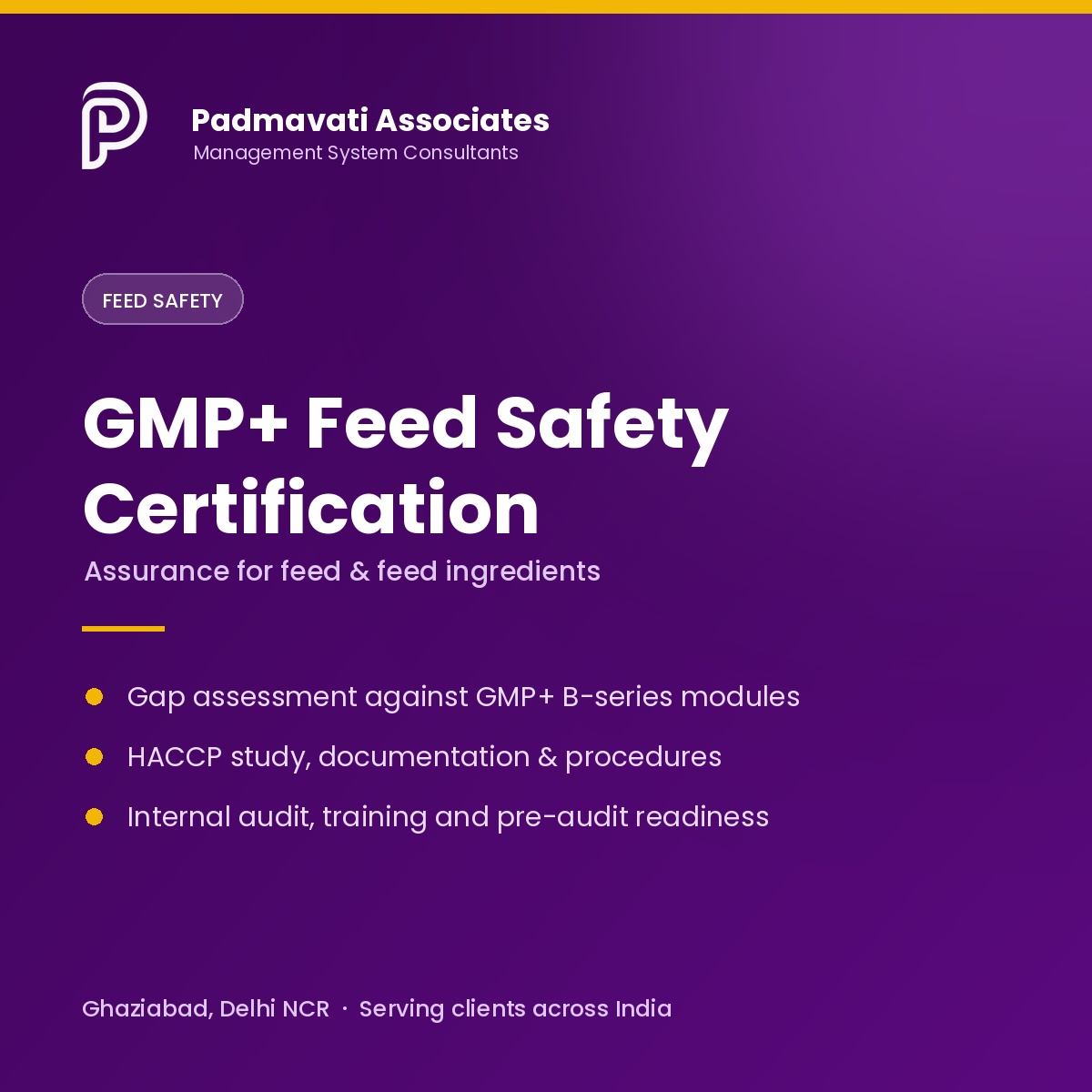

The feed-chain assurance scheme European buyers require of anyone producing, trading or transporting feed materials.
A GFSI-recognised retailer standard graded AA to D. Buyers read the grade, not just the certificate.
ISO 22000 plus sector PRPs and additional FSSC requirements — the scheme most global food buyers accept.
The hazard-control foundation every food scheme is built on. Often the first thing a buyer asks to see.
The general management-system standard: define the process, control it, prove it improves.
Environmental aspects, impacts and legal obligations under control and demonstrably improving.
Worker safety managed as a system with participation, not a folder of forms.
The ISO food-safety management standard, and the base FSSC 22000 sits on.
Information risk managed against the Annex A control set, with a Statement of Applicability that stands up to scrutiny.
A US attestation report on security, availability, processing integrity, confidentiality and privacy controls.
The automotive industry's information-security assessment, based on the VDA ISA catalogue.
A maturity-level appraisal of how consistently an organisation executes its own processes.
The manufacturer's declaration that a product meets EU directives, backed by a technical file.
The first management-system standard for organisations building or deploying AI.
Bribery risk assessed and controlled — due diligence, gifts, reporting, and top-management commitment.
Energy performance measured against a baseline and driven down against real indicators.
A verified inventory of the greenhouse gases your organisation emits, split into Scope 1, Scope 2 and the Scope 3 categories that matter to you.
The global accounting framework most customer questionnaires and disclosure programmes are written against, including market-based and location-based Scope 2 reporting.
Preparation for an independent verifier to check your emissions claim to a stated level of assurance.
The cradle-to-gate or cradle-to-grave carbon footprint of a specific product, calculated on a declared functional unit.
The embedded-emissions data EU importers must report for covered goods such as iron and steel, aluminium, cement, fertilisers, hydrogen and electricity.
A life-cycle assessment of water use and water-related impacts across your sites and products.
The Business Responsibility and Sustainability Report structure Indian listed entities file, and the ESG data packs unlisted suppliers are now asked for.
The four-pillar ethical audit — labour standards, health and safety, environment and business ethics — that retail buyers commission through Sedex.
Disruption planned for as a system: what must keep running, how fast it must recover, and proof the plan has been tested.
The quality system regulators and notified bodies expect from medical device manufacturers and their suppliers.
The manufacturing practice requirements Indian Schedule M and WHO-GMP inspectors apply to premises, equipment, documentation and quality control.
Indian food regulatory compliance: the right licence category, correct labelling, and a Schedule 4 hygiene system that passes an FSSAI inspection.
The accreditation standard for laboratories: proof that methods, equipment and staff produce results that can be relied on.
Standard and scheme names are used for identification. G2 provides independent implementation and audit-readiness support; certification is issued by an independent certification body.
Fees stay tied to your actual scope: standard, sites, headcount, current readiness and deadline.
We separate what the buyer needs from what a salesperson is trying to sell.
Controls, records and training are designed around the way your team actually operates.
Internal audit, finding closure and support through the independent certification audit.
29 detailed standard pages connect requirements to timelines, deliverables and commercial outcomes.
Feed by-products pull the whole plant into a feed-safety scheme nobody planned for.
GMP+ · FSSC 22000 · HACCPAdulteration and pesticide-residue controls that retail auditors examine line by line.
BRCGS · FSSC 22000 · FSSAIEuropean buyers check the GMP+ database before they open the quotation.
GMP+ B1 / B2 / B3Schedule M and WHO-GMP alongside commercial quality expectations.
WHO-GMP · Schedule M · ISO 9001Food customers pushing their own audit requirements one tier down.
BRCGS Packaging · ISO 9001Traceability and temperature control across sites you do not own.
BRCGS S&D · GMP+ B3Enterprise security questionnaires arriving faster than they can be answered.
ISO 27001 · SOC 2 · CMMIOEM information-security requirements with scope decisions that drive the cost.
TISAX · ISO 27001We will tell you what applies, what can be reused and what the shortest credible path looks like.